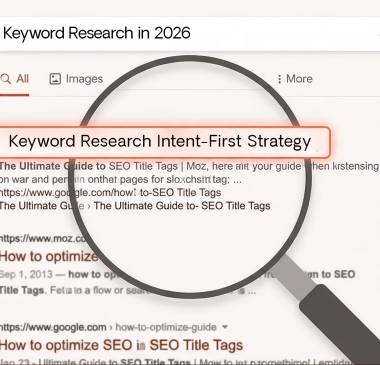
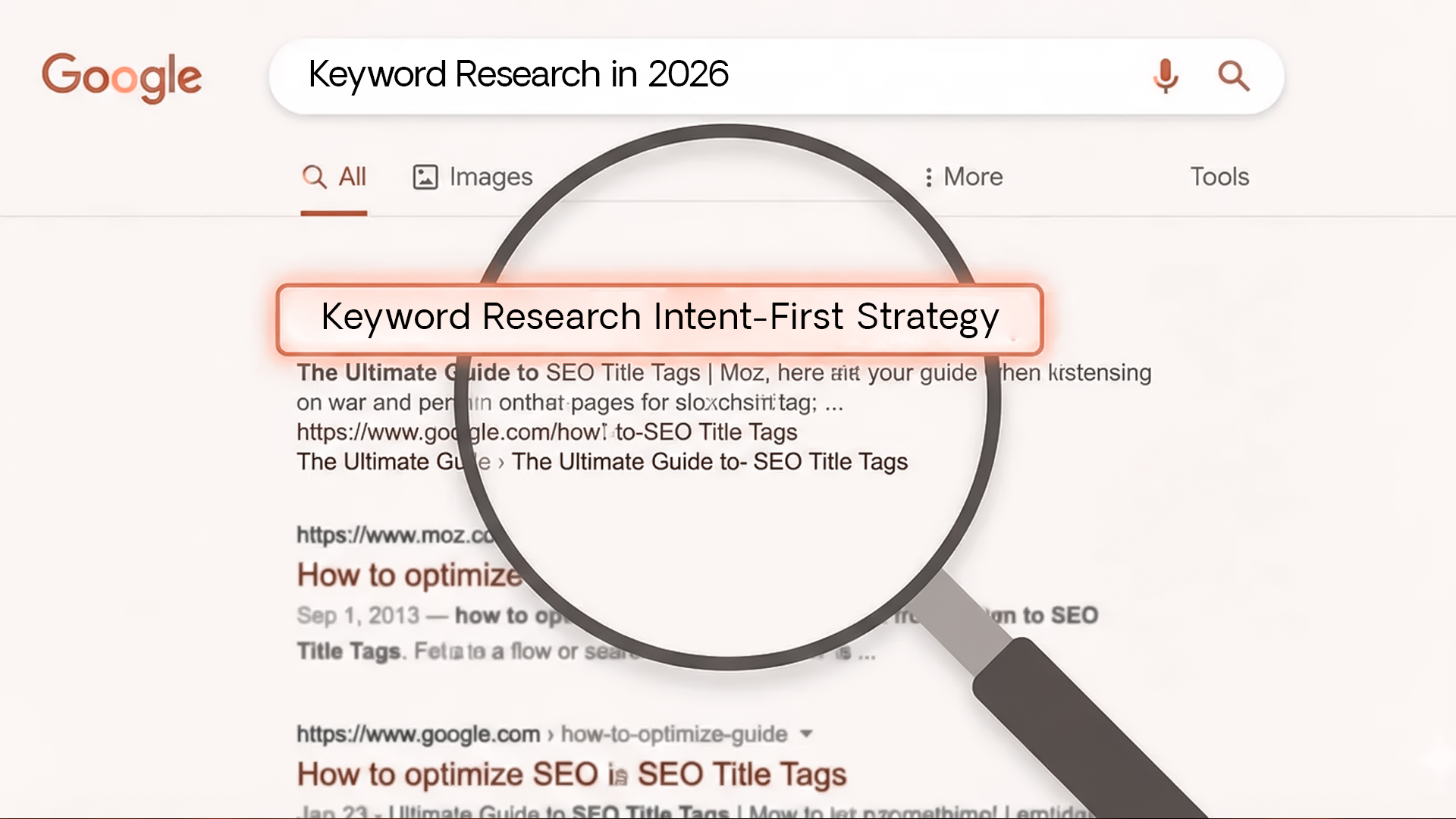
Keyword research in 2026 means identifying the exact questions, problems, and decisions your target audience is searching for, then matching your content to the intent behind each search, not just the words used.
Volume-first keyword research is a 2019 strategy. In 2026, Google’s AI algorithms, AI Overview dominance, and zero-click search behavior mean that chasing high-volume keywords without matching intent produces traffic that converts to nothing, or no traffic at all.
The most successful SEO professionals have shifted to an intent-first keyword strategy: identify what the user is trying to accomplish, then build content that is the clearest, most authoritative answer.
The Four Types of Search Intent (Updated for 2026)
Understanding intent is the foundation of modern keyword research. Every search query fits into one of four intent categories:
1. Informational Intent
The user wants to learn something.
- Example: “what is technical SEO”
- Content match: educational blog post, guide, explainer
2. Navigational Intent
The user wants to find a specific page or brand.
- Example: “Robiz Solutions contact”
- Content match: brand pages, contact pages, specific tools
3. Commercial Intent
The user is researching options before making a decision.
- Example: “best SEO agency for small business”
- Content match: comparison pages, case studies, service overviews
4. Transactional Intent
The user is ready to act.
- Example: “hire SEO agency”
- Content match: service pages, pricing pages, booking flows
The mistake most brands make: Writing informational content for transactional keywords, or creating service pages for informational queries. The match between intent and content format is more important than keyword density.
How to Do Intent-First Keyword Research: Step by Step
Step 1: Start With Your Customer’s Problems, Not Your Services
Before opening any keyword tool, write down the 10–20 most common questions your customers ask before hiring you or buying from you. These are your seed keywords. Real customer language is almost always better than industry jargon.
Step 2: Expand With a Keyword Research Tool
Use Google Keyword Planner, Semrush, Ahrefs, or similar tools to expand your seed keywords. Look for:
- Long-tail variations (3+ word phrases)
- Question-format keywords (“how to,” “what is,” “why does”)
- Local modifiers if relevant (“SEO agency USA,” “digital marketing Canada”)
Step 3: Analyze SERP Intent Signals
For each keyword you’re considering, search it manually. Look at what types of content currently rank:
- If blogs rank → the intent is informational
- If service pages rank → the intent is commercial or transactional
- If product pages rank → the intent is transactional
Create content that matches the format of what’s already ranking. If you write a blog post for a transactional keyword, you will rarely rank above service pages.
Step 4: Evaluate the AIO Landscape
For your target keywords, check whether Google AI Overviews appear. If they do, you need GEO-optimized content (structured, definition-rich, question-driven) to get cited — not just ranked.
Step 5: Map Keywords to the Buyer Journey
Assign each keyword to a stage:
- Awareness stage: Informational keywords → blog posts, guides
- Consideration stage: Commercial keywords → comparison pages, case studies
- Decision stage: Transactional keywords → service pages, CTAs
Ensure you have content at every stage. Most brands over-index on decision-stage content and have nothing capturing awareness-stage traffic.
Step 6: Prioritize by Business Value, Not Volume
A keyword with 200 monthly searches that your ideal client types when ready to hire is worth more than a keyword with 20,000 monthly searches that drives curious browsers who will never buy. Score keywords by:
- Relevance to your actual services
- Intent alignment with your content capabilities
- Competition level vs. your domain authority
- Proximity to a buying decision
Keyword Research for AI-First Search in 2026
In 2026, you should also research keywords through an AI lens:
Ask ChatGPT and Perplexity your seed questions. Look at how AI answers them and what sources are cited. This reveals the content format and structure that AI systems consider authoritative.
Target question-format keywords specifically. “How does X work,” “what is the best X for Y,” and “why does X matter” format keywords are the queries most likely to trigger AI Overviews, and the most valuable to rank for in AI-first search.
Build answer clusters. Group related questions into topic clusters. A cluster of 5–8 articles covering all angles of a topic is more powerful than 5–8 disconnected keyword-targeted posts.
How Robiz Solutions Approaches Keyword Strategy
At Robiz Solutions, keyword research is the discovery phase of every SEO engagement. Our Performance Marketing team builds intent-mapped keyword strategies that connect awareness-stage content to transactional landing pages through structured internal linking.
We combine traditional keyword data with AI citation analysis, identifying not just which keywords have volume, but which keywords will earn AI Overview citations and which are closest to actual purchase decisions. This approach is reflected in results across our SEO case studies.
Contact us to build a keyword strategy for your business.
Questions About Keyword Research
One primary keyword and 3–5 closely related secondary keywords per page. Trying to target more dilutes focus and confuses search engines about what the page is primarily about.
Yes, for baseline volume data. However, it should be combined with intent analysis, competitor SERP review, and AI search behavior research for a complete picture.
Focus on long-tail keywords (4+ words), question-format queries, and local modifiers. These naturally have lower competition than short, generic terms while often carrying stronger commercial intent.
Analyze competitor keyword rankings to identify gaps — topics they’re not covering well where you can create a clearly superior resource. Direct keyword overlap is less important than finding underserved intent.
Quarterly for core strategy, with monthly monitoring of keyword rankings and search volume trends. AI search behavior changes rapidly enough in 2026 that annual keyword audits are no longer sufficient.
Keyword cannibalization is when multiple pages on your site target the same primary keyword, causing them to compete against each other. This splits authority and often causes neither page to rank well. Each primary keyword should map to one canonical page.
Yes. Searches on TikTok, YouTube, Instagram, and Reddit reveal how your audience actually phrases their questions. These social search queries often translate directly to blog and content opportunities.
Published by Robiz Solutions – robizsolutions.com