AI automation is the combination of artificial intelligence, specifically large language models, machine learning, and computer vision, with workflow automation platforms to handle tasks that require understanding, judgment, and adaptation, not just data processing and rule-following.
Traditional automation executes fixed rules: if X, then Y. AI automation understands context, interprets unstructured inputs, makes decisions, generates content, and learns from outcomes. The combination has created a category of business capability that was effectively impossible for most organizations five years ago.
In 2026, AI automation is not a futuristic concept. It is in active production use at businesses of every size, handling everything from customer support to content creation to financial analysis.
Traditional Automation vs. AI Automation: The Critical Difference
| Traditional Automation | AI Automation | |
| Input type | Structured data (forms, spreadsheets) | Unstructured data (emails, documents, conversations) |
| Decision logic | Fixed rules (if/else) | Dynamic reasoning (understand intent, choose path) |
| Adaptability | Breaks when inputs change | Adapts to variation |
| Tasks suited for | Repetitive, predictable steps | Judgment-based, language-dependent tasks |
| Examples | Invoice generation, data sync | Email classification, content generation, ticket routing |
The combination of both, traditional automation for structured processes, AI automation for judgment-based tasks, is what defines an AI-enabled operation in 2026.
How AI Automation Works: The Technology Stack
A typical AI automation system uses several layers:
1. Trigger Layer
Something initiates the workflow: a new email, a submitted form, a webhook from an external system, a scheduled time, or a human request.
2. AI Processing Layer
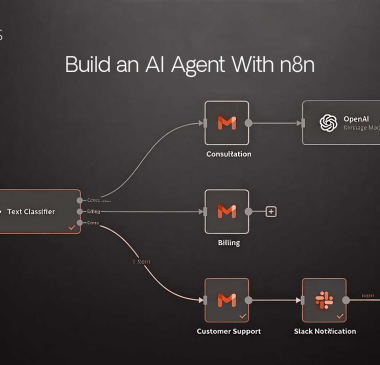
An LLM (GPT-4, Claude, Gemini, or a specialized model) processes unstructured inputs:
- Classifies the type of request
- Extracts relevant entities (names, dates, amounts, intent)
- Makes decisions based on context and instructions
- Generates outputs (responses, documents, summaries, recommendations)
3. Tool Layer
The AI connects to external tools and systems to take actions:
- Databases and CRM systems
- Communication platforms (email, Slack, SMS)
- Document and file management systems
- External APIs and data sources
- Other automation workflows
4. Output and Logging Layer
The automation produces its output (a response sent, a record created, a document generated) and logs the full interaction for monitoring, compliance, and improvement.
The 8 Business Functions Being Transformed by AI Automation in 2026
1. Customer Service and Support
AI automation handles routine support inquiries, classifies and routes complex issues, generates personalized responses, and maintains consistent service quality at any volume, without proportional staffing costs.
Businesses using AI-powered support report 40–60% reduction in first-tier support volume handled by humans, with customer satisfaction scores maintained or improved.
2. Sales and Lead Management
AI automation qualifies incoming leads, enriches contact data, personalizes initial outreach, schedules discovery calls, and maintains CRM hygiene, allowing sales teams to focus exclusively on high-value conversations.
3. Marketing Operations
Content briefing, SEO reporting, social media scheduling, ad performance monitoring, and campaign analytics are all candidates for AI automation, enabling leaner marketing teams to manage larger outputs.
4. Finance and Billing
Invoice generation, payment reminders, expense categorization, and financial reporting are highly repetitive, structured processes with clear AI automation ROI.
5. HR and Recruitment
Resume screening, interview scheduling, candidate communication, and onboarding workflows can be substantially automated, reducing time-to-hire and improving candidate experience.
6. Legal and Compliance
Document review, contract drafting assistance, compliance monitoring, and regulatory reporting are increasingly handled by AI automation, not replacing legal professionals, but dramatically reducing their manual document workload.
7. IT Operations
Incident detection, ticket routing, system monitoring alerts, and automated remediation workflows reduce mean time to resolution and free IT teams for strategic infrastructure work.
8. Content and Creative Production
Research, briefing, drafting, editing, and distribution workflows for content teams can be substantially automated, enabling higher content volume without proportional team growth.
The AI Automation Stack That Powers Robiz Solutions’ Client Delivery
At Robiz Solutions, AI automation is not just a service we offer, it is how we operate. Our internal workflows for client reporting, lead management, content production, and performance monitoring run on n8n-based AI automation systems that we have built and refined over dozens of iterations.
Our AI Agency services extend this capability to clients: we build custom AI automation systems for marketing operations, customer service, sales enablement, and business processes. Our Tech & Digital Engineering team handles the full implementation; from requirements definition through deployment and ongoing optimization.
We have used AI automation across client engagements including SEO case studies and performance marketing campaigns that depend on automated data collection, analysis, and reporting at scale. Our Staff Augmentation service also includes AI automation specialists who can embed in client teams.
Contact Robiz Solutions to assess your AI automation opportunities and build a roadmap for implementation.
Questions About AI Automation
RPA automates interactions with user interfaces; clicking, typing, navigating screens in a scripted way. AI automation uses AI to understand and process unstructured content, making decisions that RPA cannot. They are complementary: RPA handles legacy system interactions; AI automation handles judgment-based tasks.
Financial services (compliance, reporting, customer service), healthcare (documentation, scheduling, patient communication), e-commerce (order processing, customer support, inventory management), and professional services (legal, marketing, consulting) are seeing the highest adoption and ROI.
AI automation replaces specific tasks, not roles. The humans previously doing those tasks either shift to higher-value work within the same role or are redeployed to areas of greater strategic need. The net effect on employment varies significantly by organization, strategy, and how productivity gains are reinvested.
Look for processes that are: repetitive (done frequently), rule-based (follow clear patterns), time-consuming (take significant hours from your team), involve unstructured data (emails, documents, conversations), and have clear right/wrong outcomes. These are the highest-value automation candidates.
Over-automating without adequate human oversight. AI systems make mistakes, especially on edge cases and unusual inputs. The most successful implementations include monitoring systems, escalation paths, and regular audits of AI output quality.
Entry-level AI automation (using platforms like n8n with GPT-4 API) requires moderate technical literacy. Enterprise-grade AI automation with custom models, fine-tuning, and complex integrations requires specialized expertise. Many businesses partner with an AI agency for implementation.
Primary metrics: hours of manual work eliminated per week, error rate reduction, process cycle time reduction, cost per task (human vs. automated), and employee satisfaction with work quality. Secondary metrics: customer satisfaction impact, revenue per employee growth, and scalability (volume handled without added headcount).
Published by Robiz Solutions – AI-Enabled Digital Marketing Agency robizsolutions.com | AI Agency Services | Contact Us